Community housing is a form of affordable housing that works alongside private housing in the open market. Typically, community housing organisations are not-for-profit groups that meet housing needs through a range of affordable rental and home ownership options.
They provide an alternative to the public housing provided by Kāinga Ora (formerly Housing New Zealand) and local authority housing. CHA, alongside Te Matapihi, serves as a voice for these diverse organisations.
Community housing organisations provide around 30,000 homes throughout New Zealand. These may be provided by faith-based, iwi, hapū or Pacific groups that offer tenancy advice services or provide homes directly.
These organisations provide warm, safe, dry, and affordable homes through a range of housing options, including emergency and transitional housing, affordable rentals, and home ownership assistance.
Many providers originally began as social services or health services and have added housing to their offerings as they recognised its importance in improving social and health outcomes. Some organisations provide additional wrap-around support services directly, whilst others ensure necessary support links are available for their residents.
The sector is diverse, long-term orientated, and takes many shapes and forms. However, it is unified by a single idea and possibility: the goal of ensuring all people are well housed.
Regulation and registration of CHPs
The Community Housing Regulatory Authority (CHRA) is an independent agency within the Ministry of Housing and Urban Development that registers and regulates Community Housing Providers (CHPs) in New Zealand. Organisations that demonstrate the ability to meet the CHRA Performance Standards become registered as Community Housing Providers. Since 2014, Registered Community Housing Providers have been able to provide homes to those on the Public Housing Register, and access the Income Related Rent Subsidy. Other community housing organisations that are not registered cannot access the subsidy, but still offer alternative affordable housing options for rent and purchase.
The community housing sector in New Zealand remains small compared to other countries, and many New Zealanders still need access to good housing. Community housing organisations, whether registered CHPs or not, are actively working to increase the number of available homes, to ensure all New Zealanders have adequate housing. International evidence shows that those countries with a thriving large-scale, charitable, non-governmental housing sector tend to have significantly better outcomes for low and moderate income households.
More than just housing: The deeper purpose of community providers
Local providers typically have strong community connections and a vested interest in growing social cohesion, especially when working with vulnerable households. Relationships matter profoundly: When people know you, know your name and know you care, the likelihood of achieving successful outcomes rises consistently and dramatically.
Community housing providers are not-for-profit entities focused on values, principles, and purpose. This means they consistently work in this space for the long-term and tend to be deeply experienced, well-connected, and trusted advisors in their communities.
The importance of charitable purpose cannot be overstated. Affordable housing and the money that is deployed to deliver it, must be retained and recycled in perpetuity for the system to deliver long-term, intergenerational affordability. If this is not the case, most affordable products last one iteration and are then lost to the market.
The collective lived and worked experience within the community sector far surpasses that of other players in the housing market. There are tens of thousands of years of collective experience in the sector workforce.
For example, over 50% of the 500 attendees surveyed at the 2023 Community Housing Aotearoa (CHA) national conference, had more than 10 years of directly relevant work experience. Community housing providers largely hold the institutional memory of New Zealand's housing system. They understand what works and why it works and have led much of the innovation that is unique to the context of New Zealand's housing system.
Building connections: How community housing goes beyond shelter
Community housing providers have built relationships and trust over time, earning a strong social licence to operate within their communities. This invisible but crucial aspect of the sector's success is hard-won and easily-lost. In many contexts, it enables projects to succeed where they might otherwise have failed.
These providers are recognised as friendly landlords, calculating rentals based on what works for households, and what they can afford, rather than maximising financial profit.
For generations, community housing providers have approached housing through a more holistic lens, serving their communities. Some now describe this approach as an Environmental, Social, and Governance (ESG) strategy.
Māori and Pacific people's community housing providers deliver a wide range of services, products, and programmes. Many of these are delivered without government involvement or funding, as community-minded individuals serve their communities' needs. Many aspects of this service provision often go unrecognised in official government reporting.
Reimagining housing: Innovation and social cohesion
The community sector is deeply committed to creating more pathways and accessible entry points for households to have greater sovereignty and choice over their housing arrangements.
A comprehensive housing needs assessment, forms the foundation for developing a well-matched supply-side solution. By understanding pre-existing community connections, providers gain a significant advantage in providing the right house, with the right tenure, in the right place and at the right price. Community housing providers believe in community building, which means creating mixed, diverse, and inclusive developments and delivering homes, not just houses.
The ability of community housing providers to deliver a variety of tenures allows them to respond with tailored solutions matched to household aspirations and needs.
The most successful community-led developments deliberately include shared spaces, community hubs, and 'bump spaces' (a public space to promote community connection), to support residents in getting to know each other in mixed-tenure environments. Placemaking is crucial in rebuilding social connectedness and cohesion.
A sector of many voices: The varied landscape of community housing
Community housing providers come in many shapes and sizes. Many emerge from post-treaty settlement iwi and hapū, whilst a substantial number have faith-based origins associated with churches, mosques, temples, or synagogues. They range from large organisations managing thousands of homes to small providers working in special interest areas or in rural towns.
The community housing sector has a diverse whakapapa. Some organisations originated from social service backgrounds or decades of running successful community health services.
They are geographically diverse and unevenly capitalised. Many of the largest CHPs are tangata Te Tiriti organisations that have had preferential access to government grant funding and Income Related Rent Subsidy (IRRS) contracts, often at the expense of tangata whenua organisations.
Community providers have a strong track record of innovation, evident in new ownership structures, tenure models, finance mechanisms, papakāinga, and marae activations. The sector leads the way working with partners in developing new housing supply, financing, alternative tenures, leasehold structures, and community land trusts.
A commitment to change: Addressing New Zealand's housing shortage
Many are dedicated housing organisations with a determined focus on local delivery. What all providers share is a commitment to fulfilling the right to a decent home - providing housing and access to people entitled to warm, safe, secure, and affordable homes.
New Zealand's housing challenge is fundamentally because of affordability. For decades housing prices have increased much faster than household incomes. Increasing the available stock of affordable rentals and home ownership options has become a growing priority.
A provider need not be a registered Community Housing Provider to deliver these important products and services.
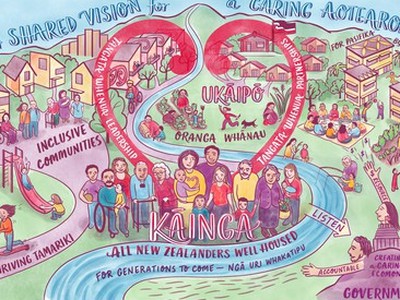
Ultimately, all providers are united by a shared goal – seeing all New Zealanders well housed. And they will persist until that goal is achieved.